How to Read Your MEPCO Bill — Every Field Explained
A MEPCO bill looks crowded, but it is really five blocks of information stacked in a fixed order. Once you know where each block sits, you can check your own bill in about two minutes — and spot a mistake before you pay it.
Why understanding your bill matters
Most people look at only two things on a bill: the total and the due date. That is understandable, but it means a wrong meter reading, an unexpected slab change or an old arrear quietly carried forward can pass unnoticed month after month. Reading the bill properly lets you spot errors while they are still easy to correct — a reading that does not match your meter is far simpler to fix in the same month than after three more bills have been built on it.
It also helps you predict your charges. When you know which line is the cost of your units, which line moves with fuel prices, and which lines are fixed taxes, a higher bill stops being a mystery: you can usually point to the exact line that grew, and decide whether the cause is your own usage or something worth questioning.
One reassurance before we start: the printed bill delivered to your home and the online copy on the official PITC bill page show the same fields in the same layout. Everything in this guide applies to both, so you can follow along with whichever copy you have in front of you.
See your own bill while you read
This guide is much easier to follow with your own bill open beside it. Use the checker below — your bill opens in a new tab on the official PITC page, so you can keep this guide open here and compare each block as we walk down the page.
Check your MEPCO bill now
Free — no sign-up, no app needed. Your bill opens on the official PITC page in a new tab.
If that tab shows the PITC search page instead of your bill, copy this number and paste it there: ✓ Copy ho gaya
Or open the official PITC search page and paste it there — or go via the official MEPCO website.
The top section — your connection
The Consumer Detail box at the top of the bill describes whose connection this is and how it is billed. These fields change rarely, so if any of them is wrong, it is worth getting corrected once rather than ignoring it every month:
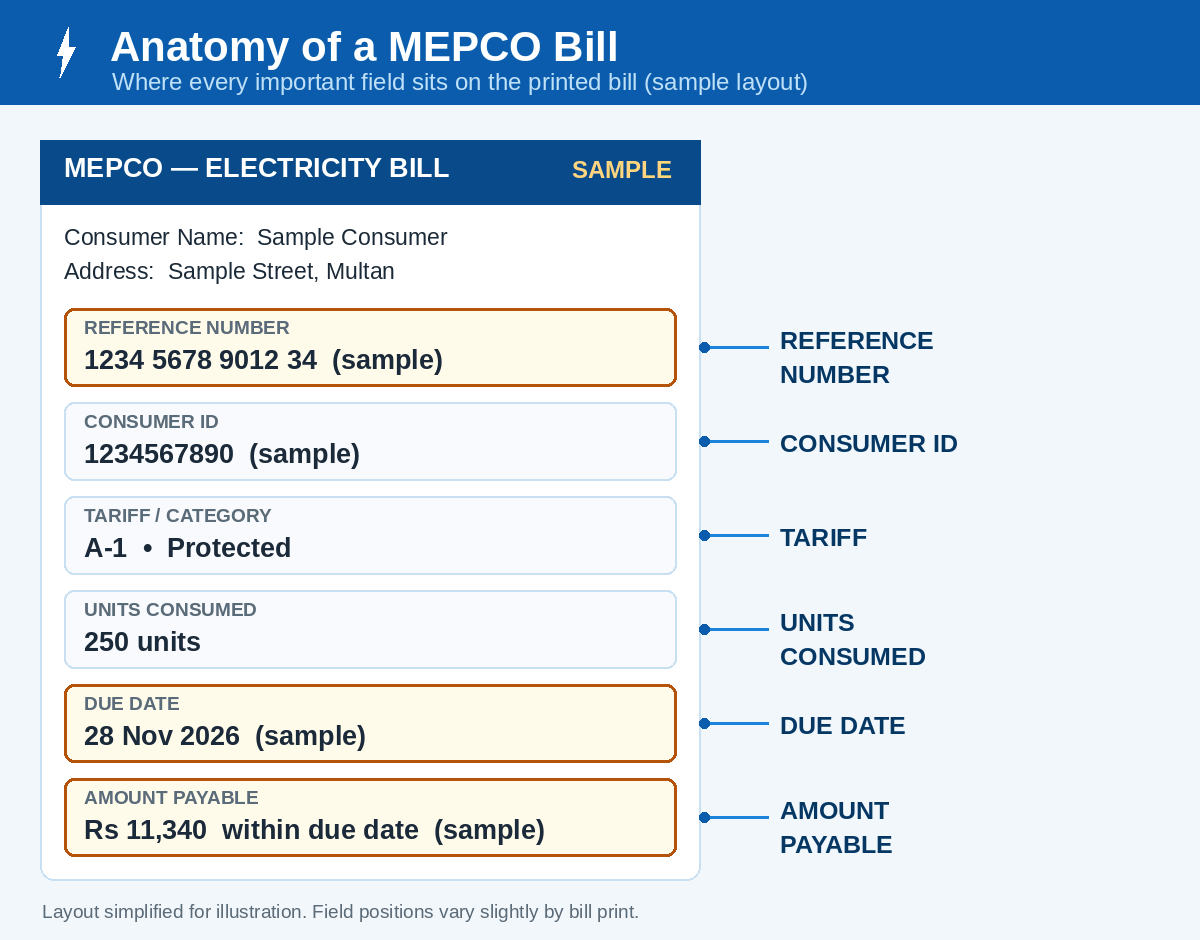
- Consumer ID — a 10-digit customer number that identifies your account with MEPCO. It is the alternative key for checking your bill online; see the consumer ID guide for where it sits and how to use it.
- Reference number — the 14-digit number, printed with a letter such as U or R at the end, that identifies your connection's billing record. This is the number every payment channel asks for; the reference number guide explains how to find and recover it.
- Name & address — the registered consumer's name and the address of the connection. A wrong name matters when you sell the property or apply for other services, so get it fixed at your sub-division office if it is not yours.
- Tariff code — the category you are billed under, for example A-1 for an ordinary domestic connection. If the code carries a trailing T, the connection is billed on time-of-use rates instead of slabs, with separate peak and off-peak prices — see how peak hours work before you judge the bill.
- Sanctioned load — the load in kW that MEPCO has approved for your connection. It matters because fixed charges are billed per kW of sanctioned load, so an oversized load costs you money every single month.
- Meter number — the serial number of the meter installed at your premises. Match it against the number plate on your physical meter if you ever suspect your bill belongs to someone else's meter.
The reading block
Below the consumer details sits the reading block, which records what your meter said at the start and end of the billing period. It shows the previous reading, the current reading, and the reading dates on which the meter reader recorded them.
The maths is simple: units consumed = current reading − previous reading. If last month's reading was 12,450 and this month's is 12,700, you are billed for 250 units. This one subtraction is the foundation of the whole bill — every charge that follows is built on the units figure — which is why comparing the printed current reading with the number on your own meter is the single most useful check you can make.
Occasionally a bill is issued on an estimated or provisional reading, for example when the meter could not be accessed on the reading day. The bill is marked accordingly, and the difference is normally adjusted in a later bill once an actual reading is taken. If estimated bills repeat for several months, raise it with your sub-division office rather than letting a large correction land all at once.
The charges block
This is where the units turn into money. The first and largest line is the cost of electricity: your units multiplied by the slab rate that applies to your category and usage level. Whether you are billed as lifeline, protected or unprotected changes this line dramatically, so it is worth checking the slab table in the MEPCO tariff 2026 guide against your own units at least once.
Next come the fixed charges, billed per kW of your sanctioned load at the rate for your slab. They are charged whether you use many units or few, which is why a month away from home still produces a bill.
The third element is the Fuel Price Adjustment (FPA) — a per-unit amount set monthly by NEPRA to pass through the real cost of the fuel burned to generate your electricity. It is charged on your units, it changes from month to month, and it can occasionally be negative. Our bill charges explained guide goes through FPA and every other line in detail.
Taxes, fees & adjustments
After the energy charges, the bill adds the government levies. The biggest is GST — sales tax at 18%, charged on your energy charges, fixed charges and FPA combined. Then comes electricity duty, a provincial duty of 1.5%, and the flat TV fee of Rs 35 per month collected with the bill. Some bills also show a small meter rent or a quarterly/tariff adjustment line; each of these is broken down in the guide to bill charges.
Two lines in this part of the bill are about history rather than this month. Arrears brought forward are unpaid amounts from earlier bills carried into this one — if you believe you already paid them, do not ignore the line, because it will keep travelling forward. On the other side, credits and adjustments reduce your bill when you have overpaid or a past error has been corrected in your favour. If you have an approved installment plan, the installment lines appear here too, showing the portion of the old balance included in this month's total.
The two amounts
Near the bottom, the totals box prints two figures side by side, and the difference between them is pure timing. Payable within due date is the full amount of the bill with no penalty — this is the figure to pay. Payable after due date is the same bill plus a late payment surcharge, and it is what you will owe if the payment lands even one day late.
The due date printed beside these amounts is the last day on which the lower figure is accepted. Paying through a bank or wallet app on the due date itself is normally fine, but leaving it to the last evening is risky if an app or the payment system is down, so treat the day before as your real deadline.
The same area of the bill also reflects the payment status of your last bill — whether the previous month was paid, and if so, when. If you are ever unsure whether a payment actually landed, work through the checks in our bill paid or not guide before paying a second time.
Spotted something wrong?
Start with the simplest test: read your meter today and compare it with the current reading printed on the bill, remembering that you will have used some units since the reading date. If the printed reading is clearly ahead of what your meter shows, or the units, slab or arrears do not match your records, the bill can be corrected — follow the step-by-step route in our wrong bill guide, and take a dated photo of your meter before you visit the office.